







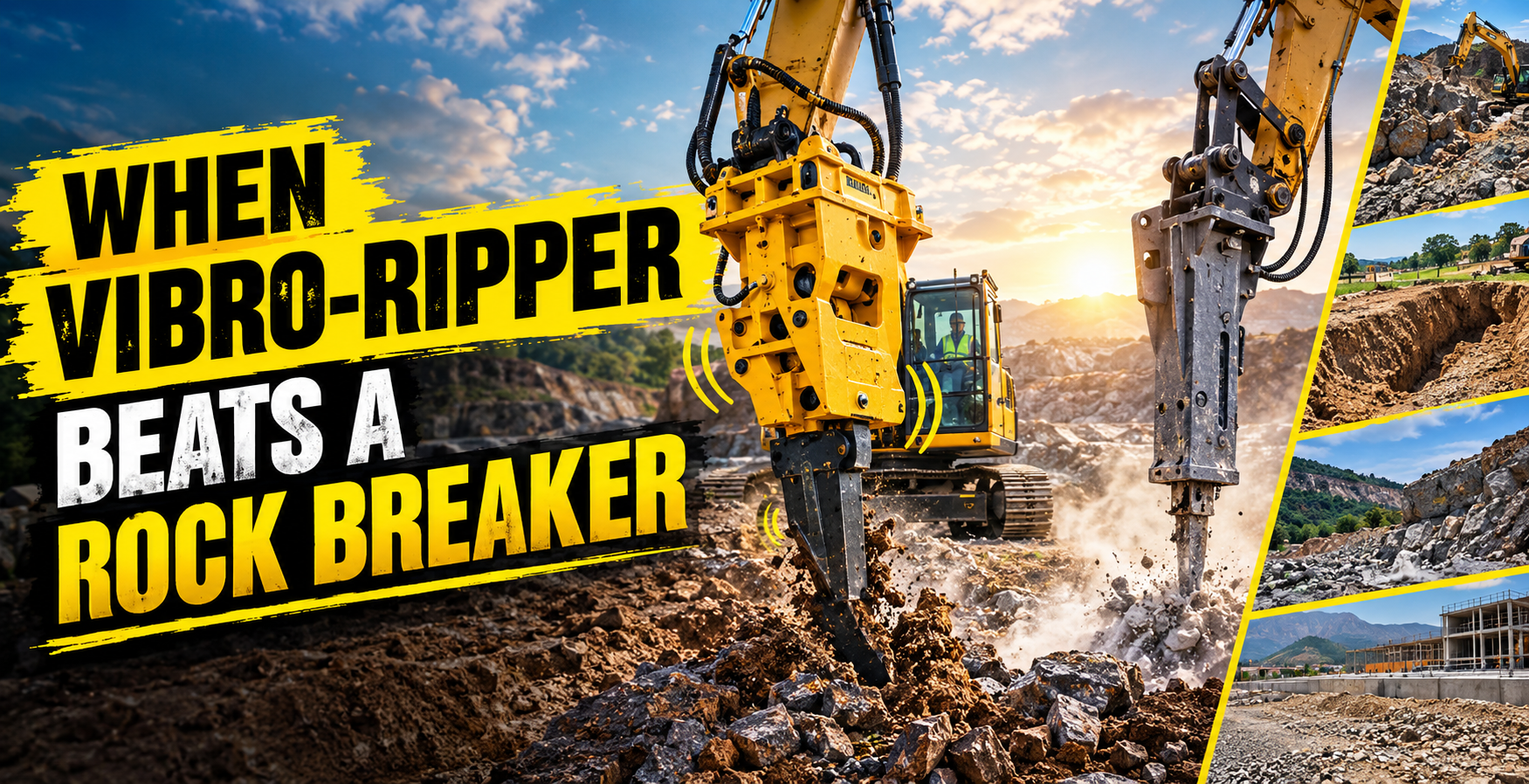
When to Use a Vibro Ripper Instead of a Rock Breaker
Rock breakers are widely used for breaking hard rock and concrete, but they are not the right
solution for every application. A vibro ripper takes a different approach to material separation
and can be effective where controlled breaking, lower impact, reduced noise, and minimal
ground disturbance are important.
The choice between a vibro ripper and a rock breaker depends on several factors, including
material characteristics, site conditions, environmental constraints, required productivity, and
project requirements.
Understanding Vibro Ripper Technology
A conventional rock breaker uses repeated percussion and impact energy to fracture material.
While highly effective in many demanding applications, impact-based breaking can generate
considerable noise, vibration, and material disturbance.
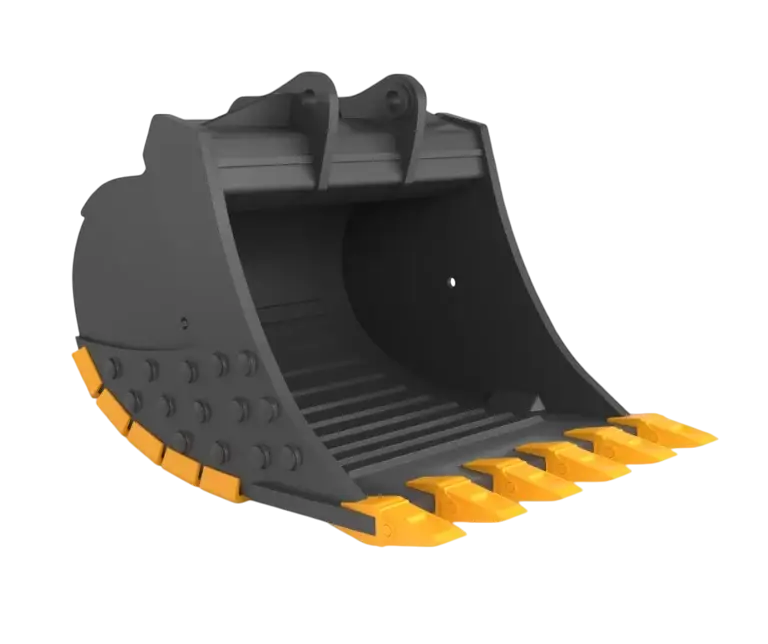
A vibro ripper works on a different principle. Instead of repeated impact, the attachment applies
continuous high-frequency vibration to the material. This creates internal stresses and fractures
that allow suitable rock and concrete formations to break apart progressively.
This controlled working principle can make a vibro ripper suitable for applications where
excessive impact, noise, or material disturbance needs to be minimized.
Key Benefits of Vibro Rippers
• Controlled and progressive material breaking
• Lower impact compared with conventional breakers
• Lower noise levels in suitable applications
• Reduced transmission of vibration to the carrier and surrounding structures
• Less uncontrolled material shattering
• Better suitability for sensitive or restricted work areas
• Improved operator comfort during extended operations
Actual performance depends on the material type, attachment model, carrier machine, and
operating conditions.
Material Types and Application Suitability
Different materials respond differently to breaking technologies. The following comparison
provides a general guide:
| Material Type | Vibro Ripper | Rock Breaker |
|---|---|---|
| Shale formations | Excellent suitability | May cause excessive fragmentation |
| Frozen ground | Very effective under suitable conditions | May require higher impact energy |
| Reinforced concrete | Can progressively weaken suitable sections | Effective but may generate greater impact and debris |
| Limestone layers | Responds well to controlled vibration | Effective for aggressive breaking |
| Consolidated rock | Can fracture along natural planes | Effective where higher impact energy is required |
Vibro rippers can be particularly effective on materials that naturally fracture along planes or
respond well to continuous vibration.
For reinforced concrete, a vibro ripper can be used to weaken or separate suitable sections before
the loosened material is removed with a bucket or another suitable attachment.
Applications in Noise-Restricted and Sensitive Areas
One of the key considerations when selecting an attachment is the working environment. Urban
construction, demolition, and infrastructure projects may take place close to residential buildings,
schools, hospitals, utilities, or other sensitive facilities. In such situations, reducing excessive
noise and vibration can be an important consideration.
Note: Actual noise and vibration levels depend on the carrier machine, attachment model,
material, operating technique, and site conditions.
Local regulations and project-specific
requirements should also be considered when selecting and operating an attachment.
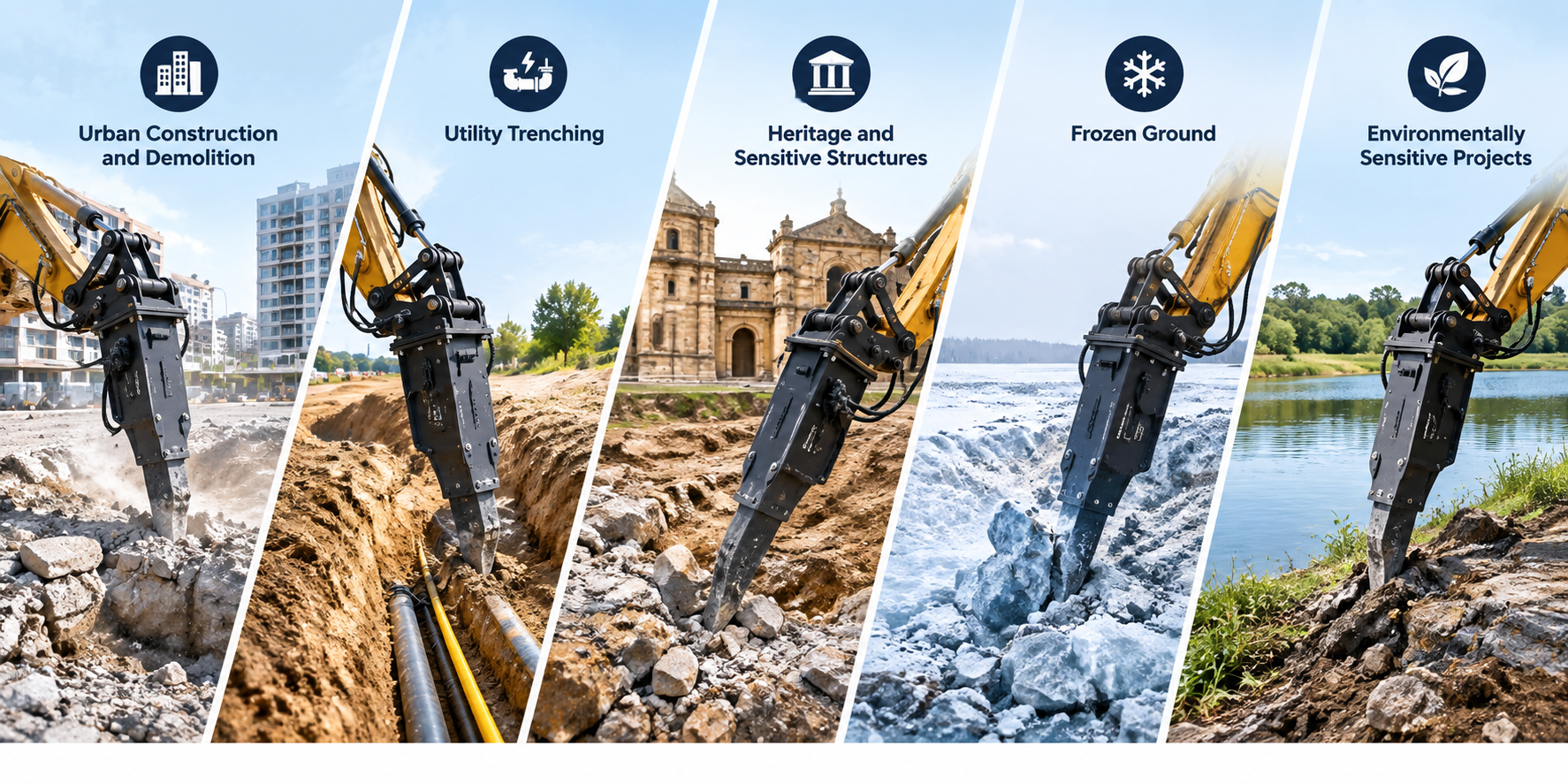
Applications Where Vibro Rippers Offer Advantages
Urban Construction and Demolition
Urban projects often involve restricted working hours, nearby buildings, and public sensitivity to
noise and vibration. A vibro ripper can provide a controlled alternative for suitable materials,
helping contractors carry out selective breaking with less impact.
Utility Trenching
Excavation near existing water, sewer, electrical, or other underground utilities requires careful
control of material removal. A vibro ripper can progressively loosen suitable rock or hard
ground, which can help reduce uncontrolled fragmentation. Proper utility identification and safe
excavation procedures remain essential.
Heritage and Sensitive Structures
Projects near historic buildings, heritage structures, or other sensitive surroundings require
careful control of excavation and demolition work. The progressive working action of a vibro
ripper can be useful where excessive impact needs to be avoided and selective material removal
is required.
Frozen Ground
Frozen or heavily compacted ground can make excavation difficult. In suitable conditions, a
vibro ripper can progressively loosen frozen ground through its vibrating working action,
allowing the excavator to remove the material in a controlled manner.
Environmentally Sensitive Projects
Projects near water bodies, environmentally sensitive areas, or other restricted locations may
require careful management of noise, vibration, and material disturbance. A vibro ripper can be
considered where controlled excavation is required and the ground conditions are suitable.
DOZCO Vibro Ripper Models
DOZCO offers vibro ripper models for different excavator carrier weight ranges. The V220, V320,
V450 and V550 models cover carrier classes from 20 to 65 tonnes, with differences in operating
frequency, hydraulic oil flow, service weight and attachment dimensions.
| Model | Carrier Weight Range | Key Technical Specifications |
|---|---|---|
| V220 | 20–28 ton | Frequency: 2500–3000 bpm; Required oil flow: 170–200 L/min; Service weight: 2850 kg |
| V320 | 29–36 ton | Frequency: 2500–2800 bpm; Required oil flow: 210–230 L/min; Service weight: 3750 kg |
| V450 | 37–46 ton | Frequency: 1700–1800 bpm; Required oil flow: 250–260 L/min; Service weight: 4780 kg |
| V550 | 47–65 ton | Frequency: 1600–1700 bpm; Required oil flow: 280–300 L/min; Service weight: 5780 kg |
V220
The V220 is suited to urban demolition, trenching, and controlled excavation work where
the excavator requires a compact vibro ripper for working in confined areas.
V320
The V320 is suitable for medium-scale demolition, trenching, excavation, and rock-
breaking applications where controlled material removal is required.
V450
The V450 is suited to demanding rock excavation, quarrying, and large-scale site
preparation where greater excavation capacity is required.
V550
The V550 is intended for large-scale quarrying, mining, and demanding excavation
applications where heavy-duty material removal is required.
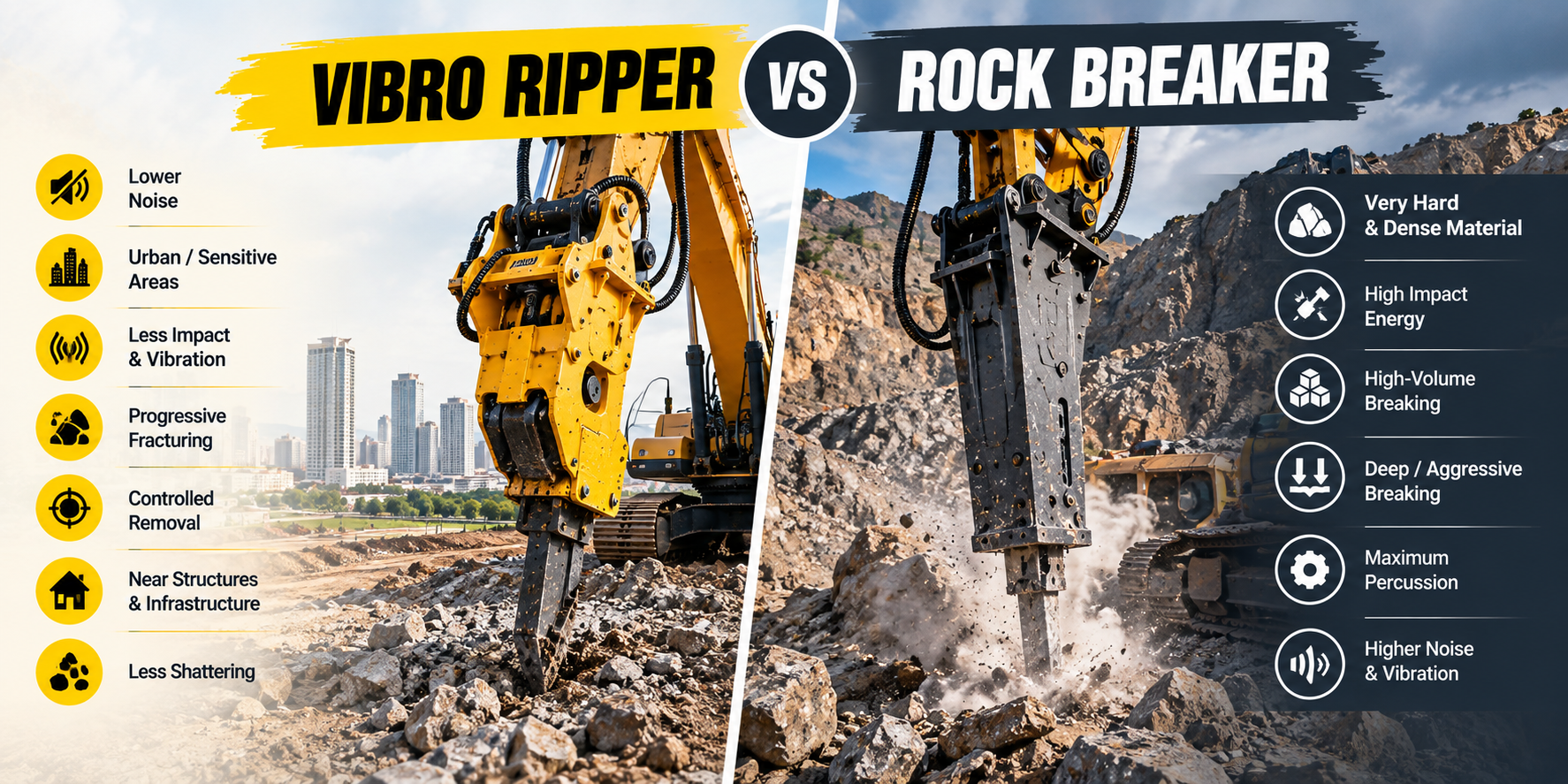
Vibro Ripper vs. Rock Breaker: Application Considerations
Neither attachment is universally suited to every breaking condition. The right choice depends on
the material, the required breaking action, and the conditions at the worksite.
A Vibro ripper may be preferred when:
● Noise reduction is an important consideration
● The project is located in an urban or sensitive area
● Reduced impact and vibration are required
● Material can be progressively fractured or loosened
● Controlled or selective material removal is required
● The work is close to structures or infrastructure
● Excessive material shattering needs to be minimized
A Rock breaker may be preferred when:
● The material is extremely hard and dense
● High impact energy is required
● High-volume breaking is the primary objective
● Deep or aggressive rock breaking is required
● The application demands maximum percussion capability
● The site permits higher levels of noise and vibration
When a Rock Breaker Remains the Right Choice
Vibro rippers are not a replacement for a rock breaker in every breaking application.
Very hard and dense rock formations, including certain granite and highly competent rock, may require the
higher impact energy of a hydraulic breaker for productive breaking.
A rock breaker may also be more suitable for high-volume quarrying and mining work where
aggressive breaking action and higher production are required. Deep rock excavation, heavy
foundation breaking, and applications that require substantial penetration can also favour a rock
breaker, depending on the material and site conditions.
Making the Right Equipment Choice
| Decision Factor | Rock Breaker | Vibro Ripper |
|---|---|---|
| Urban location | Suitable where noise and vibration can be managed | Well suited to controlled breaking applications |
| Residential proximity | Higher noise levels may require additional controls | Suitable where reduced noise is an important consideration |
| Hard, dense rock | Well suited to high-impact breaking | Suitability depends on the material |
| Layered or fractured material | Suitable | Well suited to progressive loosening |
| Noise restrictions | Additional controls may be required | Lower-impact operation can be advantageous |
| Sensitive surroundings | Requires careful operation | Controlled working can be advantageous |
| High-production breaking | Well suited | Depends on the material and application |
| Selective breaking | Suitable | Well suited to controlled material removal |
| Deep, aggressive breaking | Well suited | Depends on the material and application |
DOZCO – Complete Excavator Attachment Solutions
At DOZCO, we believe the right attachment starts with understanding the job. Different
materials, excavation conditions, and production requirements call for different working
approaches. That is why we offer both
hydraulic rock breakers and vibro rippers
as part of our excavator attachment range.
Our rock breaker range includes models from D40 to D155, along with the 5000A. Our vibro
ripper range includes the V220, V320, V450, and V550. Each range is built to address different
breaking and excavation requirements across excavator applications.
We work with customers to look at the material, excavator size, required production, working
method, and site conditions before recommending an attachment. The objective is simple: match
the attachment to the job so the excavator can work with the right tool for the conditions.
Conclusion
Vibro rippers and hydraulic rock breakers serve different excavation and breaking requirements.
Rock breakers deliver high-impact energy for demanding rock and concrete breaking,
particularly where aggressive action and high-volume production are required.
Vibro rippers offer a more controlled approach for suitable materials and applications where
reduced impact, lower disturbance, selective breaking, and better control over the working
environment are important.
The choice becomes clearer when the attachment is matched to the demands of the material and
the conditions in which the excavator has to work.
Author Details