







Why a Rock Breaker is the Best Tool for Primary and Secondary breaking

Why a Rock Breaker is the Best Tool for Primary and Secondary breaking
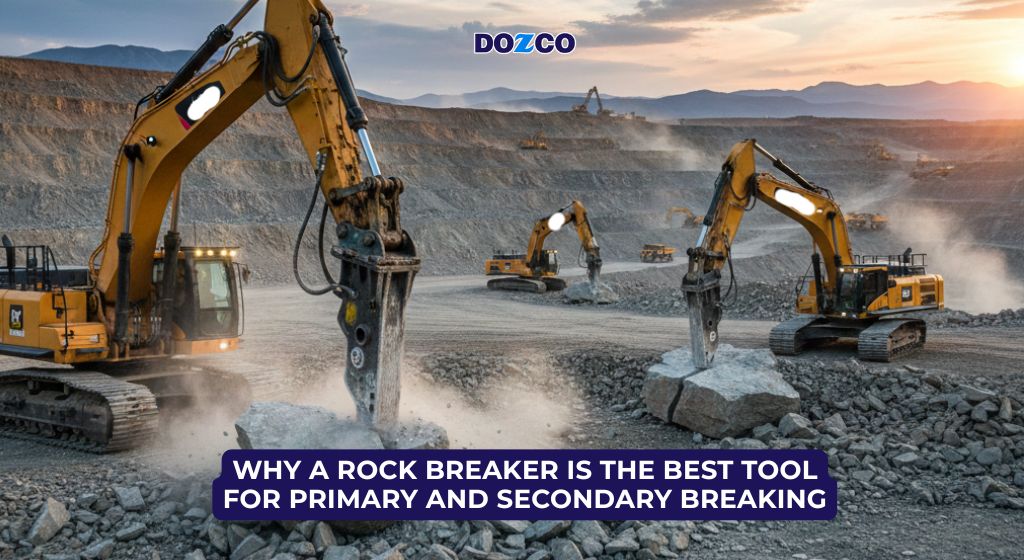
Rock breaking is an extremely challenging task when done manually. Thus, workers have now shifted to machines to do the hard work. A rock breaker is an attachment often mounted on excavators or other carriers to break down hard surfaces.
The attachment converts hydraulic power into repeated, controlled blows. It is widely used in mining, quarrying, and construction for primary and secondary breaking tasks. The tool delivers high localized stress to create cracks and dislodge fragments, rather than relying on large-scale mechanical cutting or blasting.
This article explains why rock breakers or hydraulic hammers are optimal for both primary and secondary breaking, and how their internal systems and operating practices make them effective.
What is Primary and Secondary Rock Breaking?
Let’s first understand the basics.
Primary Breaking:
It is the first stage, where the entire rock or very large lumps are broken into manageable pieces. The tasks need high-impact energy per blow and robust carrier machines. Operators often use hydraulic breakers for massive blocks in quarries or run-of-mine material in mines.
How Rock Breakers Work for Primary Breaking
Since primary breaking is for large, intact rock, the breaker is used to create large fractures and reduce block size. The process involves:
- Energy Delivery: Primary rock breaking requires higher energy. A breaker designed with large-diameter pistons and higher operating pressure can deliver greater kinetic energy per blow. In DOZCO’s heavy-duty models, the bigger piston and the nitrogen accumulator work together to increase impact force. Here, operators just have to make sure the excavator supplies the correct hydraulic flow and pressure for the breaker to perform at its rated energy level.
- Thrust & Contact: Operators must apply steady thrust so the tool stays firmly against the rock. If the thrust is too little, it causes blank firing, which leads to energy waste and can even damage internal parts of the breaker. Too much thrust, on the other hand, overloads the tool and can destabilize the machine. The ideal is to keep the tool at a 90° angle to ensure energy goes straight into the rock instead of sideways.
- Cycle Optimization: Since, for primary breaking, operators need fewer but more powerful blows, the breaker typically operates at a lower blow frequency (BPM). This approach promotes major fracture formation and prevents excessive fine particles.
Secondary Breaking:
In this process, the primary fragments are broken further to specific sizes for loading, transport, or processing. This process also requires higher blow frequency and often different types of tools to create similar sizes without producing excessive fine dust particles.
How It Works for Secondary Breaking
Secondary breaking focuses on sizing and shaping fragments produced by primary breaking.
- Energy vs Frequency Trade: A shorter piston stroke with a higher blow-per-minute rate is better for secondary breaking because the breaker needs to deliver lighter but faster impacts. These rapid strikes chip away material gradually along existing cracks instead of driving deep fractures. This progressive removal creates more even fragment sizes and prevents the rock from turning into unnecessary dust.
- Tool Selection: Selecting the correct tool reduces rebound, meaning the breaker loses less energy to bounce and transfers more of it into the rock, which improves overall efficiency.
- Operator Technique: Operator technique also plays a crucial role here. The operator begins at the block’s edges, where the rock is naturally weaker, and gradually moves across the surface to guide existing cracks outward. This prevents over-breaking and reduces the formation of excessive fines.
Choosing the Right Tool for Primary and Secondary Rock Breaking
Both primary and secondary rock breaking by using a hydraulic hammer required different tools, for instance:
Primary Breaking Needs Energy Transfer, Not Penetration
To create major fractures on large, intact, high-strength rock masses, the breaker must deliver strong compressive energy deep into the rock rather than cutting or penetrating its surface. So, a tool or chisel with a slightly broader contact area helps spread impact forces and allow stress waves to travel further inside the rock and open deep cracks.
Best tools for primary breaking:
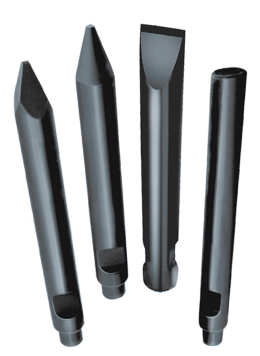
- Blunt tool
- Heavy wedge
2. Secondary Breaking Needs Penetration and Splitting
Secondary breaking shifts from deep cracking to controlled splitting. Here, the tool must penetrate the fractured zones, enter the existing cracks, and progressively open them. This controlled entry allows the operator to peel away layers, extend the fracture lines, and reduce the material to the required size without unnecessary fines.
Best tools for secondary:
- Moil point is great for penetrating cracks and directing splitting.
- Wedge chisel is good for reducing block size along fracture lines.
- Cone or pyramid tools are useful for softer rocks or concrete-like materials.
Advantages of Using Hydraulic Breakers for Rock Breaking
A rock breaker is a reliable tool for rock breaking. It comes with various advantages as well:
Improved Work Efficiency
Breakers concentrate high-impact energy at the tool tip and break rocks with precision. Modern breakers also adjust stroke length and blow frequency, allowing operators to match energy delivery to material hardness.
Avoiding Blasting Hazards
Explosives can be dangerous. It’s hard to control. Broken rock pieces fly everywhere and can injure people in the surrounding area. The ground vibrates, which can be detrimental for tunneling tasks. The toxic fumes released after the blast can also be harmful to people nearby.
Breakers provide controlled, localized rock reduction. Because the impact zone is concentrated and predictable, the attachment can be safely used for foundations, utilities, and other sensitive structures where explosives are unsuitable.
Versatility in Different Work Conditions
Breakers can be mounted on a wide range of carriers, including excavators, backhoes, and skid loaders across multiple weight classes. Proper sizing between breaker and carrier ensures stable thrust, good energy transfer, and efficient operation. DOZCO’s range covers everything from compact carriers to heavy mining machines, allowing operators to select the right configuration for both primary and secondary breaking tasks.
Reducing Tool Wear
Another advantage of using a rock breaker is that the operator can match the blow energy and frequency to rock conditions. This helps to minimize unnecessary wear. Using high energy on soft material or excessive BPM on hard rock can cause rebound, heat buildup, and premature component fatigue. Adjusting the breaker to the correct operating window reduces stress on the piston, bushings, and tool, extending service life and lowering maintenance costs.
Final Thoughts
Excavator rock breakers are widely used for heavy duty projects like construction and mining. Here, the deadline is strict, and the environment is challenging. Rock breakers are versatile and help with both primary and secondary rock breaking. The attachment can also be used for demolition, breaking asphalt and concrete, tunneling jobs, and so on. It improves work efficiency and workplace safety.
FAQs
What is the best rock breaker size?
The best size depends on your carrier weight and the hardness of the rock. A breaker should be 10–20% of the excavator’s operating weight for optimal performance.
What materials can a rock breaker break?
Rock breakers can break hard rock, boulders, concrete, asphalt, ore bodies, and reinforced structures, depending on tool selection and breaker size.
What is the easiest way to break a rock?
Using a hydraulic rock breaker is the easiest method because it delivers controlled, high-impact energy that opens cracks quickly without blasting.
Should I use a jackhammer or rock breaker?
Jack hammer is for light demolition projects. For primary and secondary breaking, you need powerful blows; hence, an excavator rock breaker that runs on hydraulic power is ideal.