







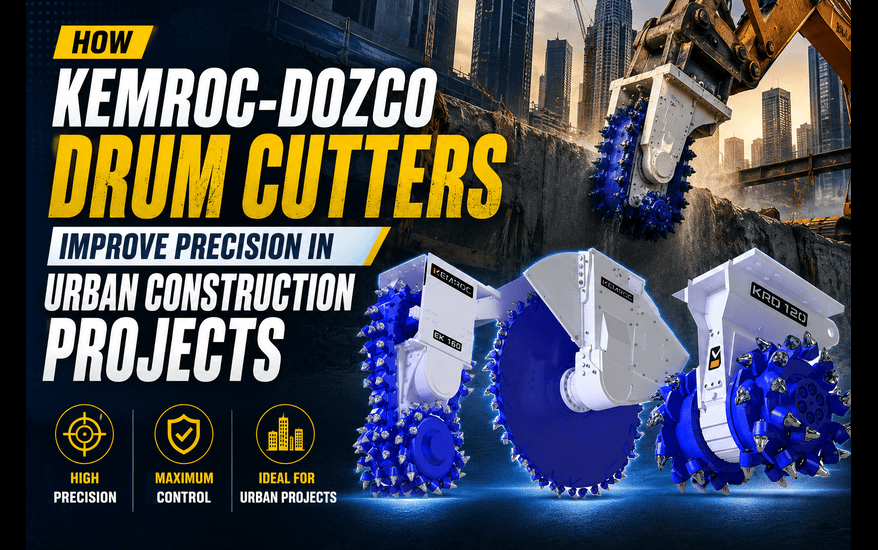
How KEMROC-DOZCO Drum Cutters Improve Precision in Urban Construction Projects
Urban construction projects demand absolute accuracy. Work proceeds within centimeters of the main waterline and gas lines. Buildings with decades of history surround the work zone. One equipment error can damage critical infrastructure or weaken adjacent structures.
Traditional excavation methods create serious problems under these conditions. Rock breakers pound with massive force. The impacts travel through soil and rock. Vibrations crack building foundations, and noise complaints shut down projects. Overbreak removes more material than specifications allow.
Urban environments need a different approach. Contractors need tools that cut exactly where intended without disturbing nearby infrastructure. Drum cutters have fundamentally changed how urban excavation works.
Why Urban Sites Need Specialized Equipment
City construction sites present challenges you won’t find in open areas. Space limits equipment access. Underground utilities cross every block. Existing structures sit right next to excavation zones. Residents and businesses operate within meters of active work.
Standard excavator attachment systems, like rock breakers, work through repeated impacts. Each strike sends shock waves through the ground. These impacts can crack a foundation wall three meters away. They can damage buried pipes. They consistently create noise that violates city regulations.
These projects need precision that traditional methods cannot deliver. They need controlled material removal. They need an excavator attachment that cuts without creating secondary damage.
How KEMROC-DOZCO Drum Cutters Work Differently
A drum cutter for excavator operations uses rotating drums fitted with hardened cutting picks. The excavator’s hydraulic system powers the rotation. The picks penetrate concrete, rock, or frozen ground through continuous cutting action.
No hammering. No repeated impacts. Just steady, controlled cutting.
The attachment fits standard excavators, compact excavators, and mini excavators. You select the size based on workspace and cutting requirements. The hydraulic connection provides the torque needed to slice through hard materials.
Here’s the operational sequence: Drums rotate at controlled speeds. Cutting picks engage the material surface. Each pick removes small amounts with every rotation. Material comes away in manageable pieces instead of unpredictable chunks.
This cutting action differs completely from how rock breakers work. Impact tools deliver single, powerful strikes. Drum cutters deliver thousands of controlled cuts per minute.
Precision That Protects Surrounding Infrastructure
Urban projects need accuracy measured in centimeters. You’re trenching for utility lines next to a subway tunnel. You’re creating a foundation space between two occupied buildings. You’re profiling rock near century-old brick structures.
Drum cutters let you remove material layer by layer. The rotating drums cut to exact depths. You maintain precise trench widths. Your excavation profiles match engineering specifications.
Compare this to a rock breaker. The breaker strikes hard. Material fractures unpredictably. You might remove too much in one area or not enough in another. That inconsistency creates rework and potential structural issues.
Precision cutting also protects what you’re not supposed to touch. The drum removes only the material directly under the cutting picks. Surrounding rock, soil, and structures stay intact. No shock waves are traveling through the ground. No unintended damage to adjacent infrastructure.
Foundation work near existing buildings shows this advantage clearly. You need to excavate rock right next to load-bearing walls. A hydraulic breaker’s impacts could compromise those walls. A drum cutter removes the rock without affecting the structure.
Vibration Control in Sensitive Areas
Vibration damages urban infrastructure faster than most contractors realize. Repeated impacts from rock breakers create progressive stress. Building foundations develop small cracks. Underground pipes shift and separate at joints. Historical structures with old masonry suffer the most.
Cities now enforce strict vibration limits on construction sites. Exceed those limits and inspectors shut you down. Your project timeline extends. Your costs climb.
Drum cutters solve this problem through continuous rotary cutting. The picks engage material smoothly instead of striking it. Vibration levels drop by 70-80% compared to rock breakers. Your excavator stays stable. Nearby structures experience minimal impact.
This matters for projects near active railways, operating subway lines, and sensitive buildings. It matters when you’re working at night in residential areas. It matters when historical preservation authorities monitor your work.
Operators notice the difference immediately. Less vibration means less fatigue. They maintain better control throughout their shift. Machine stability improves. Cutting accuracy stays consistent hour after hour.
Noise Reduction in Populated Areas
Urban noise complaints stop projects immediately. Residents file reports. City officials issue violations. Your work schedule gets restricted to midday hours only. That restriction severely reduces productivity.
Rock breaker systems create sharp, loud impacts. Each strike generates noise that carries through city blocks. Even with sound barriers, noise control remains difficult.
Drum cutters operate much quieter. The continuous cutting action produces steady operational sound instead of sharp impacts. Sound levels drop enough to meet urban noise ordinances. You can work longer hours. You avoid complaints and violations.
Night work becomes possible with drum cutters. Many urban projects need night shifts to avoid disrupting daytime traffic and business operations. Drum cutters make those shifts viable without disturbing entire neighborhoods.
Controlled Material Removal
Urban excavation often happens in stages. You cannot remove everything at once. You need to cut, assess, and proceed carefully. Underground conditions change every few meters. Unknown utilities appear. Soil conditions vary.
Drum cutters give you that control. You remove material in measured layers. Stop to inspect. Continue cutting. Adjust your depth or direction as needed.
The cutting process produces consistent material sizes. Smaller, manageable pieces instead of large, irregular chunks. This makes material handling easier in tight urban spaces. Your excavator bucket moves loads efficiently. Trucks load faster. Site cleanup goes smoother.
Working in Confined Spaces
Urban sites rarely offer open working areas. You’re working between buildings. You’re cutting under existing structures. Your excavator operates in spaces barely wider than the machine itself.
Compact excavators and mini excavators fitted with drum cutters excel in these conditions. The precise cutting lets you work close to boundaries without overbreak. You don’t need extra buffer zones for unpredictable fracturing.
The controlled operation also protects your equipment. Less vibration means less stress on excavator components. Reduced shock loading extends machine life. Your equipment takes less punishment in confined spaces where replacement and repair become difficult.
Foundation Work Next to Existing Buildings
Foundation excavation in urban areas often requires cutting rock right against existing building foundations. The adjacent structure cannot tolerate impacts or vibration. Your excavation must maintain exact dimensions.
This situation defeats rock breakers. The impacts risk damaging the neighboring foundation. Overbreak creates voids that compromise structural support. You cannot afford either problem.
A drum cutter for excavator work handles this perfectly. You cut rock flush against the existing foundation. The rotary action doesn’t transmit damaging force into the adjacent structure. Your excavation maintains precise dimensions. No overbreak. No voids. No structural compromise.
Contractors doing foundation work in established neighborhoods rely on this capability. The drum cutter lets them work confidently next to buildings while meeting engineering specifications exactly.
Utility Trenching Without Service Disruptions
Underground utilities pack urban areas. Water mains, sewer lines, gas pipes, fiber optic cables, electrical conduits all compete for underground space. Many aren’t where the old maps show them.
You need to trench for new utility installation without damaging existing services. Service disruptions cost money and create serious problems. Hit a major water main and you’ve made the evening news for the wrong reasons.
Drum cutters let you trench with precision that protects existing utilities. The controlled cutting lets you stop immediately when you encounter unexpected infrastructure. You’re not dealing with the momentum of a swinging rock breaker. The rotation stops. You assess. You proceed safely.
The smooth trench walls that drum cutters create also matter for utility installation. Clean, vertical walls make pipe installation easier. Bedding material compacts properly. The finished trench meets specifications without additional trimming work.
Equipment Durability in Urban Conditions
Urban construction sites are tough on equipment. Tight spaces mean more contact with walls and structures. Confined areas trap dust and debris. Constant repositioning in small spaces stresses machine components.
Drum cutters actually reduce wear on your excavator compared to impact attachments. The continuous cutting creates less shock loading on the machine structure. Lower vibration means less stress on boom components.
KEMROC-DOZCO builds drum cutters with heavy-duty gearbox housings. Protected hose designs prevent damage in cramped working conditions. These design features matter when you’re operating in spaces where equipment damage means expensive delays.
Reduced maintenance requirements also matter in urban settings. You cannot always bring in service equipment easily. Keeping your drum cutter running with minimal maintenance keeps your project moving forward.
Cost Control Through Precision
Urban construction carries premium costs. Real estate values are high. Delays multiply expenses quickly. Rework drains budgets. Damage claims destroy project finances.
Precision cutting with drum cutters prevents the costly problems that plague urban excavation. You remove exactly what the plans specify. No overbreak that requires additional backfill and compaction. No damage to adjacent structures that triggers repairs and claims. No rework from imprecise excavation.
The controlled operation also cuts labor costs. Your operator maintains consistent productivity without constant repositioning. Material handling goes faster with uniform cut sizes. The excavator attachment works efficiently in conditions where other methods struggle.
Projects finish on schedule because precision prevents the problems that cause delays. On-schedule completion in urban construction directly impacts your bottom line.
KEMROC-DOZCO Solutions for Urban Contractors
KEMROC-DOZCO formed as a partnership between German engineering expertise and Indian manufacturing capability. The company produces drum cutter attachments and other excavator attachments specifically for demanding urban construction conditions.
Their drum cutters deliver the precision urban projects require. High-torque cutting handles reinforced concrete and hard rock. Different drive options match different application needs. Optional dust suppression systems meet urban air quality requirements.
The protected hose design matters in cramped urban work zones where damage risks run high. Heavy-duty construction withstands the constant use that urban projects demand.
KEMROC-DOZCO backs their equipment with operator training, on-site service support, and technical assistance. When you’re working in the middle of a city with tight deadlines, that support keeps projects moving.
Contractors across India doing tunnel work, trenching, demolition, and foundation excavation use KEMROC-DOZCO drum cutters where precision cannot be compromised.
Choosing the Right Equipment for Urban Work
Urban projects need different tools than open-area construction. Space constraints, vibration limits, noise restrictions, and precision requirements all factor into equipment selection.
A hydraulic breaker or rock breaker still works for certain applications. Heavy breaking in isolated areas where impacts don’t matter. Projects where rough excavation is acceptable. Sites where precision isn’t critical.
But most urban construction needs the control that drum cutters provide. Foundation work. Utility trenching. Tunnel profiling. Demolition near occupied buildings. Any project where precision protects infrastructure and prevents damage.
Smart contractors match their excavator attachment to project requirements. They recognize when precision cutting delivers better results than impact breaking. They understand that the right tool prevents expensive problems.
The Bottom Line on Urban Precision
Cities keep growing. Infrastructure keeps aging. Construction projects keep getting more complex. The spaces available for work keep shrinking.
These conditions demand tools designed for precision work in challenging environments. Drum cutters evolved specifically to meet these demands. They cut accurately. They operate quietly. They minimize vibration. They protect surrounding infrastructure.
Urban contractors who’ve adopted drum cutters report fewer complaints, faster project completion, and lower costs from prevented damage. The precision these attachments provide isn’t just a nice feature. It’s what makes difficult urban projects actually achievable.
KEMROC-DOZCO drum cutters bring German engineering standards to Indian urban construction sites. Contractors use them because precision matters. Because adjacent structures cannot be damaged. Because projects must finish on schedule and budget.
That’s the reality of modern urban construction. You need precision. Drum cutters deliver it.
Author Details