







Why cutters are a reliable attachment for tunnelling

Why cutters are a reliable attachment for tunnelling
Tunnelling projects are not just about power. The project demands accuracy and control, especially when working in confined underground spaces. Since ground conditions often change even within short distances, operators frequently find it challenging to deal with them. Besides, excessive vibration or overbreak can quickly increase project risks and costs. This is why cutter attachments have become a dependable solution for many tunnelling operations.
Hydraulic cutters help contractors excavate, profile, and scale tunnel faces with greater control. Unlike blasting or high-impact rock breaking, cutter attachments remove material steadily while maintaining tunnel geometry. This makes the process much safer and more predictable over time.
Read on to learn more about why you should choose a cutter attachment for tunneling projects:
What Is a Cutter Attachment?
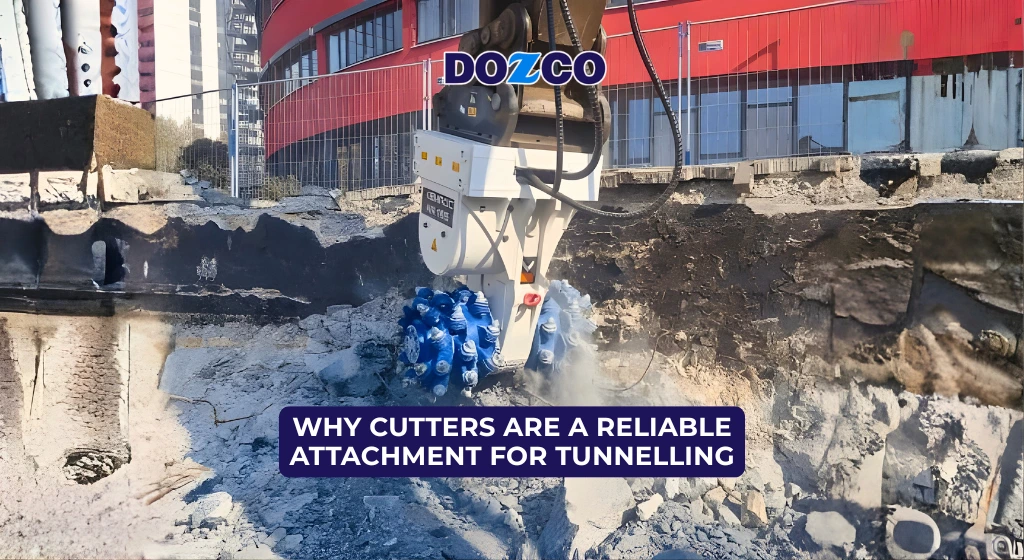
A hydraulic cutter attachment or drum cutter is a mechanically driven excavation tool powered by an excavator’s hydraulic system. These attachments do not strike the surface. Instead, they cut through material using rotating components fitted with wear-resistant picks.
These attachments convert hydraulic oil flow into torque, allowing consistent cutting performance. Because there is no repeated impact, the load on the attachment and carrier machine remains stable during operation.
The Role of Cutters in Tunnelling Work
In tunnelling, cutters are mainly used where precision matters more than brute force. They are widely applied in:
- Tunnel wall and crown profiling
- Scaling loose rock after blasting
- Bench and sidewall excavation
- Drift enlargement and cross passages
- Trenching for utilities, drainage, and cable routes inside tunnels
Drum cutters remove rock through continuous milling. With each rotation, the attachment cuts a thin layer of material. Therefore, operators can control both the depth and direction of excavation.
Since the cutting process is controlled, it reduces overbreak. Hence, operators can avoid removing rock that they haven’t planned on the excavation line. This reduces overall shotcrete volume and minimizes rework due to uneven surfaces.
Carrier Machines for Cutter Attachments
Hydraulic cutters can be mounted on a wide range of carrier machines, depending on tunnel size and job requirements. For instance, drum cutters can be attached to all sizes of excavators. For confined tunnels and utility works in urban areas, operators use the attachments on mini excavators.
For metro or road tunnels, medium-sized excavators are more suitable. Large excavators are widely used for heavy-duty mining and large-profile tunnels. Besides, drum cutters can also be mounted on backhoes and skidsteers.
Why Drum Cutters Are Considered Reliable for Tunnelling
One of the major concerns of tunneling is structural collapse. This can jeopardize worker safety as well. Drum cutters offer:
1. Consistent Performance in Variable Ground
Tunnel geology is rarely uniform. Hydraulic cutters perform well in soft to medium-hard rock and mixed ground conditions. Operators can adjust cutting pressure and feed rate based on material resistance. This helps to maintain productivity without damaging the surrounding rock.
2. Lower Vibration Compared to Impact Tools
Because cutters rely on rotary motion, vibration levels are significantly lower than those of hydraulic breakers. When tunneling is close to existing structures or in unstable rock zones, this reduces the risk of accidents. It also helps to maintain tunnel stability.
3. Accurate Tunnel Profiling
Cutters allow operators to follow designed tunnel profiles more closely. Cleaner excavation reduces:
- Overbreak
- Excess shotcrete usage
- Irregular tunnel surfaces
Over long tunnel drives, this accuracy helps control material consumption and improves overall construction quality.
4. Safer Scaling Operations
After blasting, loose rock scaling is necessary, but it can be risky. Cutter attachments enable operators to remove unstable material from a safe distance. This reduces manual scaling work and improves safety inside the tunnel.
5. Predictable Output and Workflow
Unlike drilling and blasting cycles, cutters offer continuous operation. This makes daily progress more predictable and helps contractors plan shifts, logistics, and support activities more effectively.
Why DOZCO Drum Cutters?
At DOZCO, our cutter attachments are manufactured using advanced German engineering in partnership with KEMROC. The attachments are made in India and are specially designed for heavy-duty cutting, profiling, and trenching in rock, concrete, and compacted surfaces.
Reinforced Gearbox Housing
The cutter attachments come with a heavy-duty gearbox housing to withstand continuous cutting loads. The reinforced design protects internal gears from shocks, dust, and abrasive materials. Therefore, the drum cutter runs smoothly and lasts longer in tough underground conditions.
High-Torque Cutting Drive
Our hydraulic drum cutters are available in spur-gear and direct-drive options. The attachments deliver strong torque and can cut through:
- Rock,
- Concrete, and
- Compacted ground.
Optional Dust Suppression
When working in high-dust areas, airborne particles can impact visibility. DOZCO cutter attachments come with dust-suppression systems that can help to control airborne particles. Operators can safely cut through the surface while complying with the environmental standards.
Protected Hose Routing
Drum cutters are often used in harsh environments. The sharp edge and debris can cause damage to hydraulic hoses. But with protected hose routing, DOZCO cutter attachments reduce the chance of damage, leaks, and unplanned downtime.
Underwater-Ready Operation
In many cases, drum cutters are used underwater. That is why we also have models that are designed for underwater use, with sealed components and protected bearings. This allows reliable operation in
- Water-logged ground,
- Flooded tunnels, or
- Submerged excavation areas.
Final Thoughts
Cutter attachments are a reliable tool for tunnelling. These attachments help to maintain structural integrity while slowly cutting through the surfaces. For contractors working in variable geology, confined spaces, or vibration-sensitive zones, cutters offer a practical and dependable excavation method. Their steady performance, lower impact, and profiling accuracy make them well suited for modern tunnelling challenges.
FAQs
What materials can a drum cutter cut?
Drum cutters can cut through various materials, such as soft to medium-hard rock, mixed ground, concrete, reinforced concrete, and compacted soil or fill material.
Is using a cutter attachment better than blasting?
Drum cutters help with controlled excavation. They generate low vibration and help with precise profiling. These attachments are ideal for urban tunnels, unstable geology, and areas close to existing structures.
Can cutter attachments reduce overbreak in tunnelling?
Yes. Cutter attachments remove material in thin layers. Therefore, operators can follow the planned tunnel profile closely. This reduces overbreak and lowers shotcrete consumption.
Can cutter attachments be used in water-logged or flooded tunnels?
Yes. Selected DOZCO drum cutter models are designed for underwater operation. These attachments come with sealed components and protected bearings to operate reliably in flooded tunnels or submerged excavation zones.